
Perhaps the most consequential secular shift of the second half of the 2020s is the simultaneous surge in sovereign bond yields. Simply put, a bond yield is important because it is a measure of the return investors require to lend money to the government. And they are surging all over. It is happening in a traditionally fiscally prudent country like Germany as well as in the most profligate of all, the USA.
This is all very bad. Not least because markets treat the 10-year government bond yield as a risk-free benchmark. After all, a government bond has the government’s guarantee behind it. Because of this quality, it is used as a measure of the long-term price of money. Let’s say a bank is lending you money for a mortgage loan or contemplating extending credit to a company. The question it would ask is: “Why would I take on this extra lending risk when I could instead lend to the government with virtually no risk?” The compensation it demands for taking on that extra risk is what is called the spread.
So, a surge in government bond yields means that everything everywhere all at once will get more expensive to finance. As expected, all the adults in the room are panicking.
What's amazing about the global bond sell-off is how many people are saying rising yields are about strong growth. Seriously!? You think rising yields in Japan, France, Italy or UK are about growth? We're in a global debt shock. Not a global growth shock. robinjbrooks.substack.com/p/the-dollar-d…

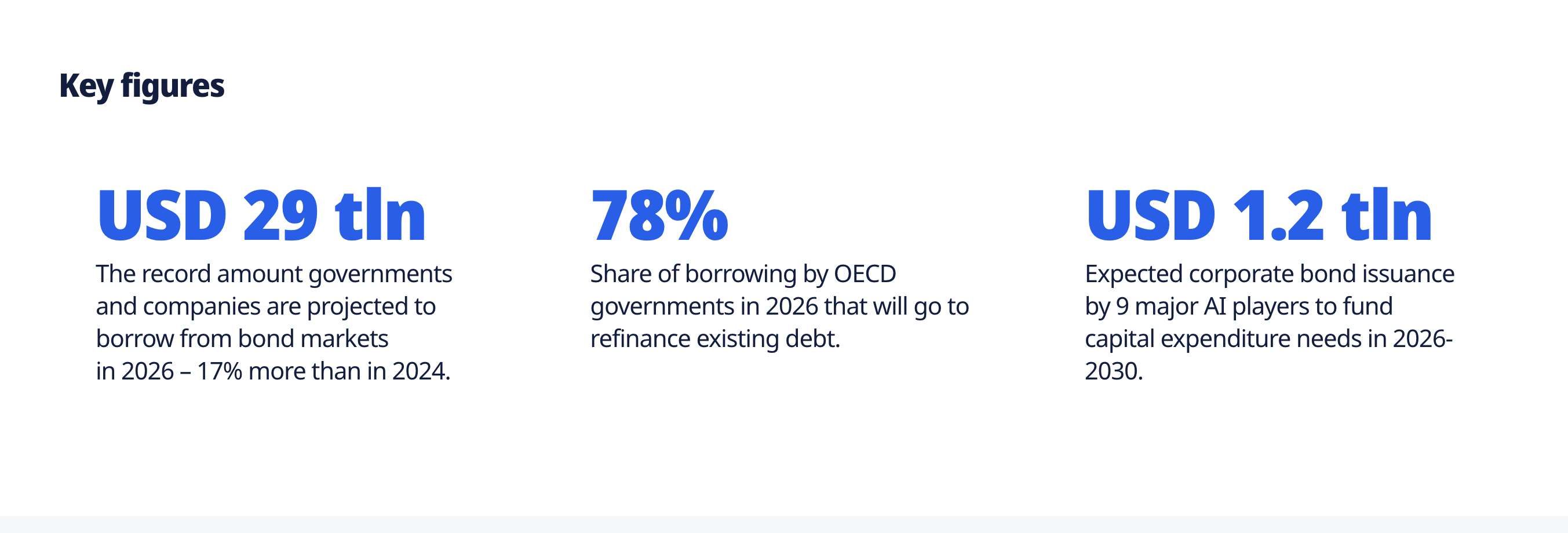
According to the latest OECD report, almost all the newly issued debt by the OECD countries is on track to be spent on refinancing the existing debt.
The world’s governments have created a $2tn monster — a debt-servicing burden that gobbles up tax revenues and has the power to overwhelm elected leaders. More money is now spent on servicing the national debt than on defence in the UK, France and the US; the same is true for more than a dozen states in the 38-member OECD rich countries’ club. Their problem is that borrowing costs have climbed to the highest level in almost two decades just as governments are taking on record debt.1
It looks like the long-dreaded doom loop has finally arrived.
"Doom Loop" Engaged: US Debt Hits $40 Trillion As Treasury Enters The Endgame
10-year Treasury yield forecast ↗
None of the usual suspects explain the trend
The 10-year government yield is the single most important number in global finance. So, the million dollar question, or should I say a 100 trillion dollar question, is understanding what drives it higher.
JUST IN: Fed Chair Kevin Warsh declares stronger growth, a capex surge and geopolitical risk are pushing the 10 year Treasury yield higher, calling it “the most important asset price in the world.”
The textbook decomposition of the 10-year government bond yield consists of two components: expected average short rates, which reflect the market’s expectations of where short-term interest rates will average over the next 10 years, and the term premium, which reflects the additional compensation investors demand for locking up their money for such a long period.
Slowly and steadily, the 30-year US Treasury yield is heading toward 5.30%, a level the economy -- and the housing market in particular-- has not seen in decades. (Bloomberg chart below.) #economy #housing #markets #bonds

Now that you know the simple algebra of it, these are some of the main culprits that drive the bond yields higher, as per market experts:
Inflation shocks, very straightforward.
Huge existing debt, also nothing new.
The end of the quantitative easing regime of the central banks.
Higher term premium demanded, also nothing surprising there as more inflation uncertainty makes locking up your money for longer more uncertain.
Possible repatriation of Japanese capital. This one has at this point turned into a Chronicle of a Death Foretold situation so hard to attribute an unaccounted rise in yields to this one.
The skepticism about government fiscal credibility. Again a factor that is being discussed since at least two generations.
My main point here is that none of the alleged drivers, nor their combination, seems sufficient to explain the simultaneous rise in sovereign borrowing costs around the world. There is another, more sinister trend at play, to which I will now turn. It is a term that we should perhaps add to the 10-year government bond yield equation. One that I call the sovereignty premium.
Enter the sovereignty premium
What if the answer is hidden in plain sight? That is to say, concealed within the nomenclature of the “sovereign” bond yield itself. What if the markets are sensing another shift in the meaning of national sovereignty and that drives the yields of national government bonds higher?
I do not mean to delve into the complicated history of the concept of sovereignty in the Western political tradition. But I do want to stress that it is a volatile concept. Perhaps more volatile than it has ever been since the year 1648. Take the simplest definition from the Stanford Encyclopedia of Philosophy:
There is in fact a definition that captures what sovereignty came to mean in early modern Europe and of which most subsequent definitions are a variant: supreme authority within a territory. 2
Or let us take the conception of sovereignty perhaps most applicable to modernity and to liberal constitutional order it entails. I mean Carl Schmitt’s famous formulation of:
“Sovereign is he who decides on the exception”

Even a brief look at some of the states of exception of our century should disabuse us of the notion that national governments still possess an uncontested claim to sovereignty.
Take for example the Great Financial Crisis of 2008. There, it was the FED and the systemically important financial institution (SIFIs) with their obscure transatlantically intertwined balance sheets, that effectively declared the state of exception. They then commandeered the political economy in service of their own interests. The precise unfolding of this process is recounted sublimely in Adam Tooze’s Crashed. I myself have also written at length on the matter in a previous piece.
The 'so called' liberal capitalism died in 2008. Not with a bang but with a whimper.
Or more recently, take the mini-budget crisis in the UK that brought down Liz Truss government. There, a state of exception was effectively declared through the bond market that helped bring a government down.
It would not be a misdiagnosis of current affairs to say that, in 2026, sovereignty no longer lies entirely with governments and their treasuries. This is precisely what the sovereignty premium would try to gauge. But how might one take a crack at measuring such a premium?
One possibility would be to accept, as a new risk-free benchmark for asset valuations, not the 10-year government bond yield but the credit yields of gigantic technology companies. That is to say, to treat the Nvidias and hyperscalers of the world as the new sovereigns. The spread between a government bond yield and the yield on the debt of an AI hyperscaler could then serve as a proxy for the sovereignty premium.
After all, one can plausibly argue that these companies are beginning to rival, sometimes surpass, governments along certain dimensions of sovereignty. We simply have no established measure for it. The idea is briefly floated in the Odd Lots episode below.
Another possibility is to look more closely at what is contributing to the fragility of Treasury markets. In his Chartbook 471, Adam Tooze shows how the increasing domination of the Treasury Market by the hedge funds contribute to the volatility of the market:
after the 2008 Global Financial Crisis (GFC); hedge funds have partly replaced primary dealers and absorbed a significant fraction of the Treasury issuance.
Adam Tooze · Chartbook 471: Still Safe? Cognitive dissonance in the Treasury market.
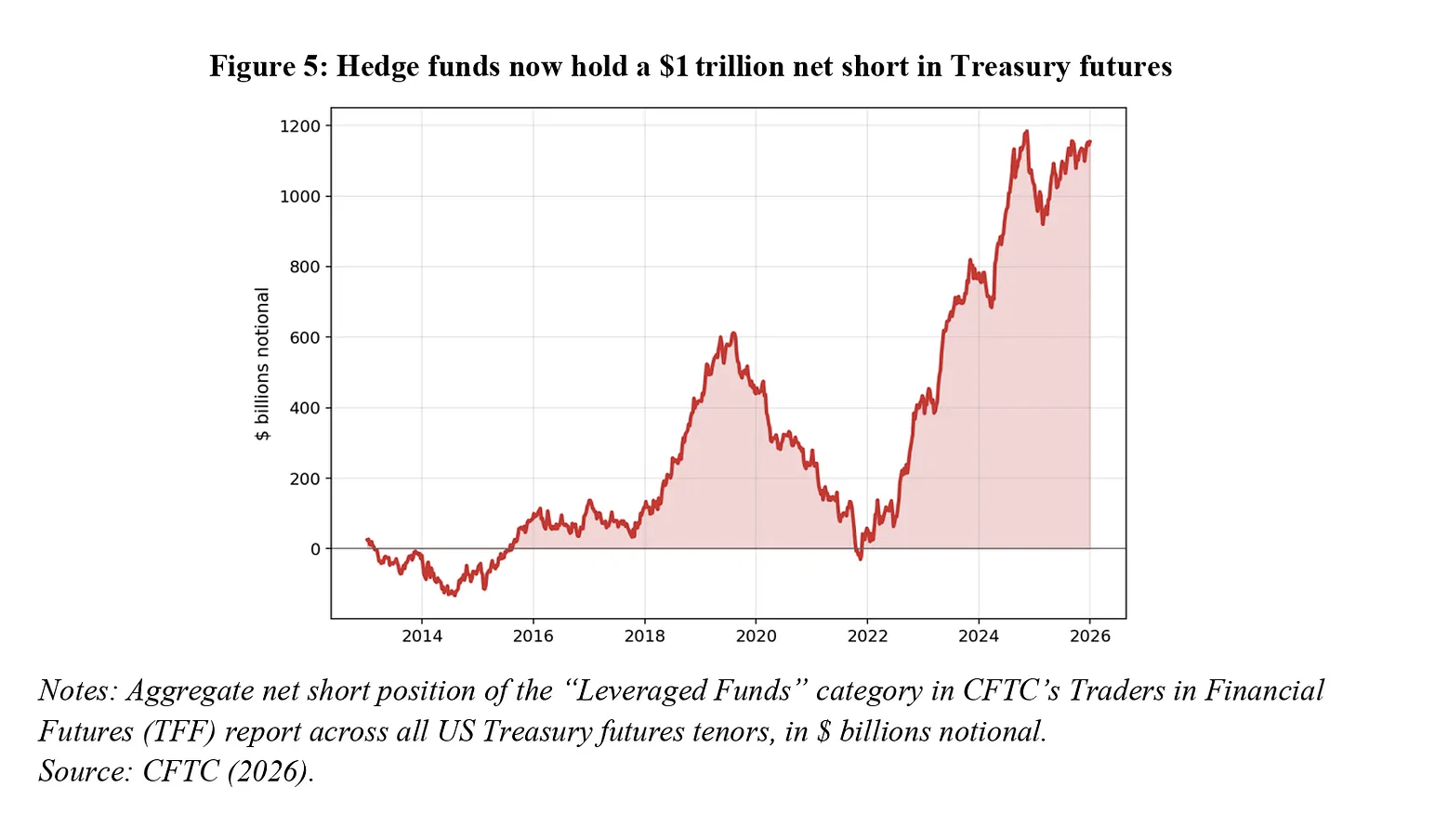
So another proxy for the sovereignty premium could be the growing domination of Treasury issuance by hedge funds and short-term traders. But I am not an analyst, and brainstorming can only take one so far.
What is certain is that we now live in a world in which sovereignty means something radically different from what it used to. And the crux of my argument is that this could not but have implications for sovereign bond yields.