If religion is a chariot, it looks as if the wheels on which it mounts towards Heaven may be the periodic downfalls of civilizations on Earth.1
Exactly 10 years ago this month, I started my Bachelor of Science degree in economics at a quite prestigious university in Europe. Looking back, it was a time of decadent indulgence for the establishment economists.International free trade models of macroeconomics á la Paul Krugman, behavioral economics, syllabi based on the sacred principles of the Obama era, with flagship books such as Why Nations Fail, all reigned supreme.
Something felt uncanny then, but everybody danced as long as the music was still playing. And indeed it took a long time for the music to change tune. As late as 2024, an Ordinarius professor from Germany’s Max Planck Institute, whom I won't name, said haughtily in a lecture that he refuses to teach tariffs because they are a thing of the archaic and irrational past. I remind you that this was 2024 and not 2016. Heedful erudites like Nassim Taleb, who pointed all this out, were treated as intellectual pariahs by the establishment.
Some fields work in theory but not in practice. Some fields work in practice but not theory. The uniqueness of economics is that it works in neither theory nor practice.
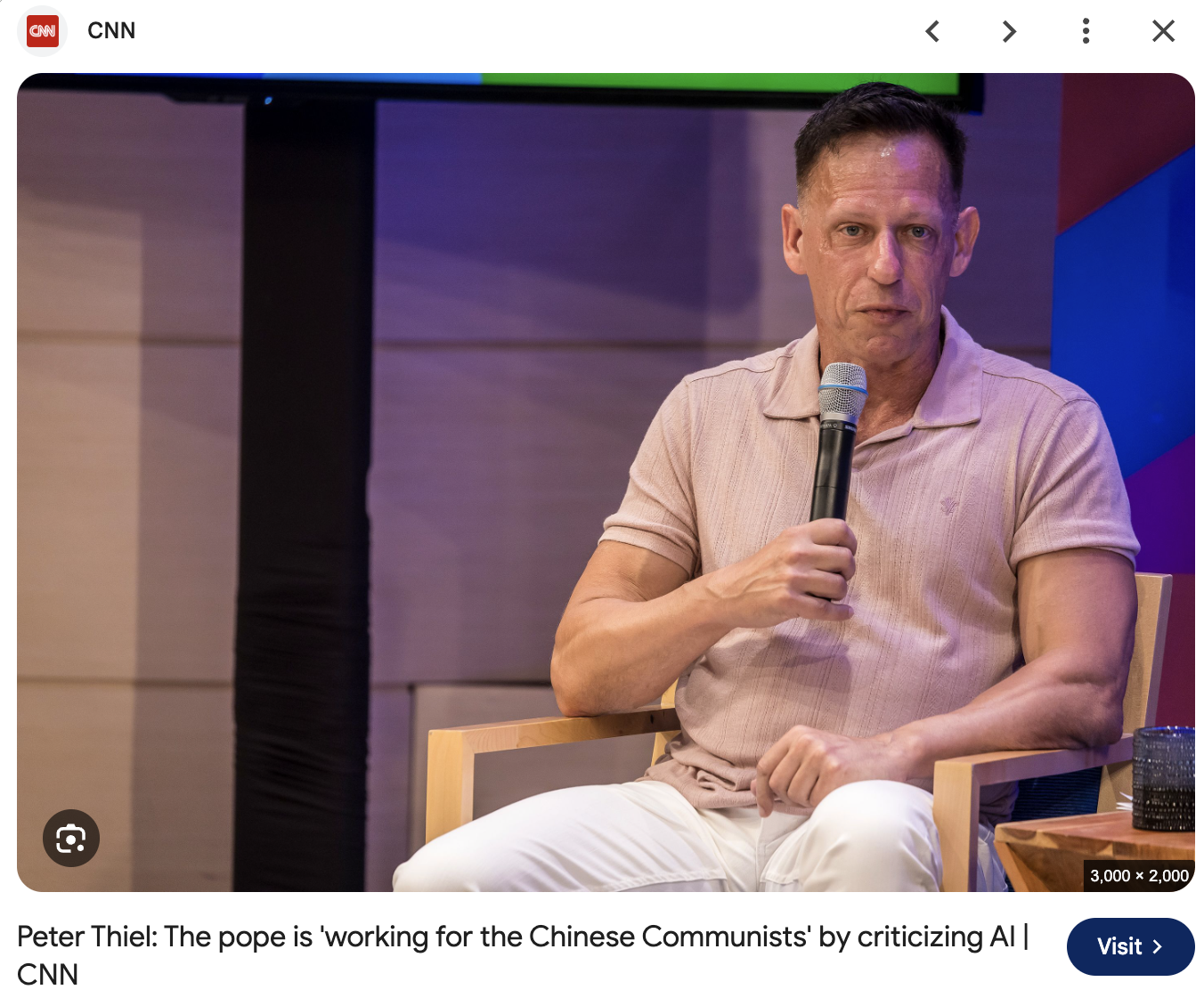
Now fast forward 10 years. Imagine for a moment you went into a coma in 2016 and woke up in 2026 to see a CNN headline that reads: Peter Thiel in Aspen: The pope is ‘working for the Chinese Communists’. We now have a world where one of the world’s leading tech billionaires routinely accuses the pope of being the antichrist and working with the Chinese Communists.
At the same time you have one of the co-founders of a company, that is at the forefront the biggest capex boom of history and that is valued around 2 trillion dollars! going to the Vatican to the launch of an encyclical on what it means to be a human in the age of Artificial Intelligence. Again, all this reads as very surreal when viewed from 2016.
NOW - Pope XIV says the church and Anthropic, will work together to "find the way for humanity, in this time of artificial intelligence."
In this new topsy-turvy world we find ourselves in, it should by now no longer surprise us that the people who received a decent education in our elite institutions are systematically incapable of processing what is happening to us. Let alone analyzing it… Look for a moment at the Toynbee quotation I’ve started this piece with. Who amongst our political or academic elite can come up with a consistent Toynbeean analysis of why theology is back all of a sudden and what is the relationship of this with the systemic economic conditions of the last decades. Or who amongst our academic establishments applies the methodology of the fascinating scholarship of the Annales school of historiography in order to draw parallels between the material crises of the 13th century and ours?For they both produced a similar surge of theological sentiments in increasingly polarized societies. (Has any mainstream European politician/ecomomist read their Duby? or le Goff I wonder?)
The economics graduates of our elite institutions can derive the Lagrangian equations to show how a marginal unit of labor affects output, but which economics graduate has the intellectual capacity to form a coherent and critical mental framework that maps the relationships between spiritual, political, and economic capital?
I do not mean (at least in this piece) to map how higher education gradually turned into places that churn out increasingly one-dimensional minds. Nevertheless, these are some of the questions that prompted me to start a tentative guide for all those perplexed about the return of theology to the center of our lives.
A tentative guide for the perplexed
The method I will go about doing this will take us back to the life of a man who lived during the turn of the 13th century. This man is known to us as St. Francis of Assisi. But to his contemporaries in the turn of the century, he was simply known as Giovanni di Pietro di Bernardone. He was the son of a cloth merchant, a member of a hitherto non-existing economic class. I have long been of the opinion that his generation is the one most recognizable to us modern individuals. It is the very first time in history that rapidly changing dynamics in a society produced a crisis of personal theology. We still live with its after-effects. Therefore, the period I am going to talk about will seem eerily familiar to most of you.
Something happened by the time Francis was coming of age that changed the static, rural, spiritually comfortable world of early Middle Ages into something much more recognizable to us. Something in which there are individuals, and a money economy and markets and unemployment and trade and all that what we came to associate with modernity. Or the capitalist mode of production or whatever you call it. Weber’s notion of Entzauberung “The disenchantment of the world” has its roots perhaps in this very juncture, even if he locates it somewhere else.
I have also argued previously that the figure of Francis is the ultimate reconciliation of the philosophical poles that preoccupied Hegel throughout his life. The life of Francis with his elaborate gestures, mostly a demonstration of his generation’s spiritual revolt to this new reconfiguration of society, are the most sublime expressions of this change.
The figure of St. Francis as the ultimate Hegelian solution
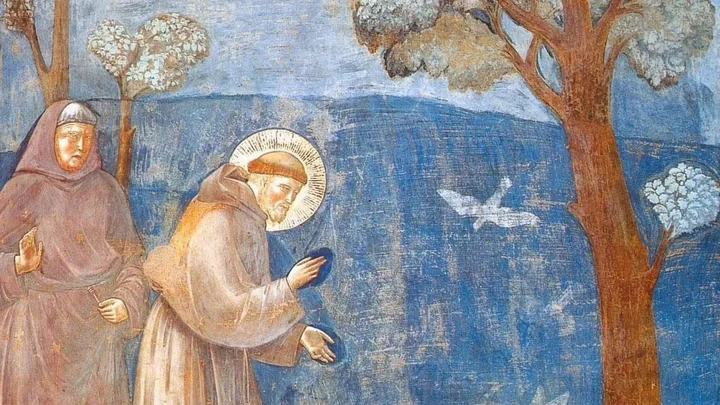
The rich visual depictions of the saint’s life provide me with an ideal canvas for mapping how a personal relationship with theology came to penetrate an individual’s life during a time of rapid political and material change. Every week I plan to take one of the sublime frescoes produced by Giotto that depict a chapter from the saint’s life and try to connect it to our world. Ideally, when I reach the end of the fresco cycle, it will start to make sense to our perplexed minds how it became possible for theology to come back into the center of our public life in a time of profound crisis.
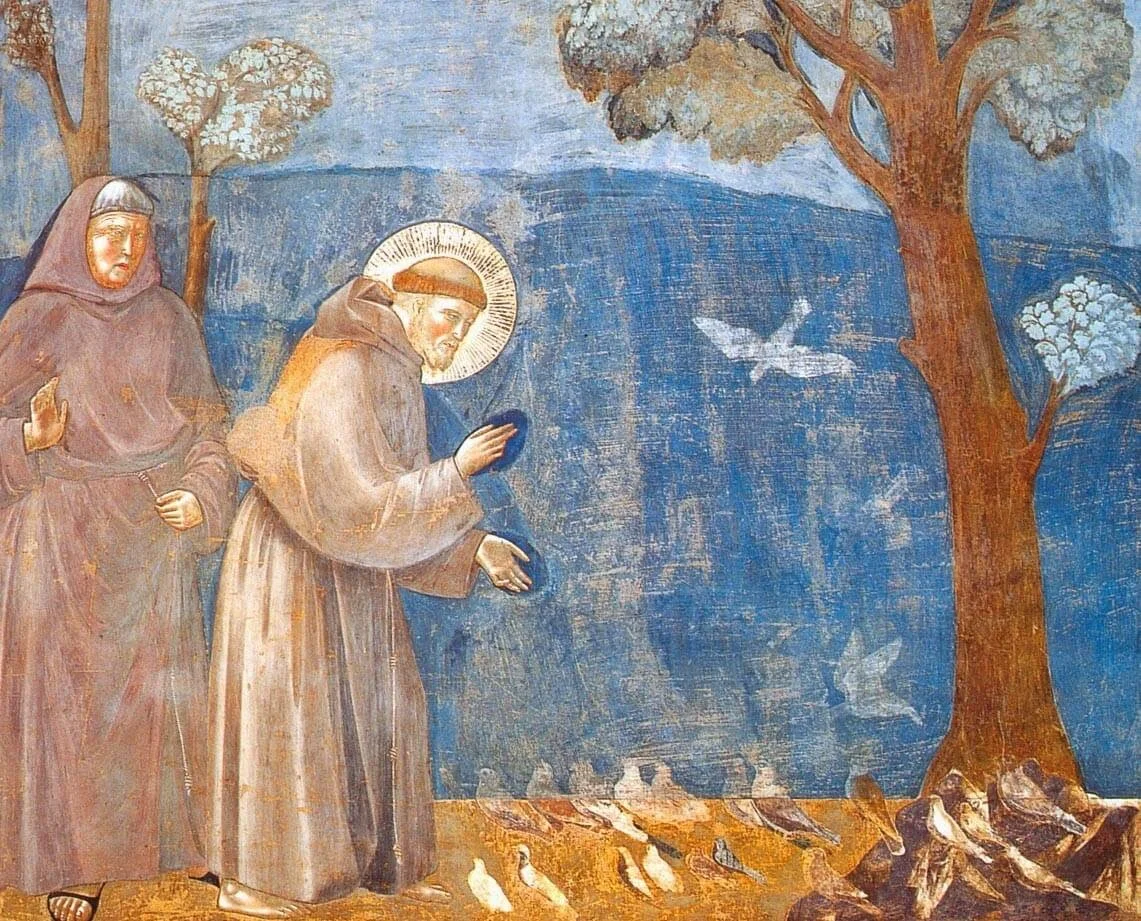
ps. It is also not coincidental that Giotto is considered by art historians as the godfather of Renaissance painting. he was the first painter after the franciscan revolution where there was a new template of personal experience of religiosity established. A conception of an immediate, personal experience of Christianity, devoid of rigid institutionalism, became possible. In that light, it is not surprising that the style that Giotto used to express this feeling launched what the posterity calls the Renaissance, further proving my thesis. but more on that later.
From the maestro Toynbee’s Civilization on Trial