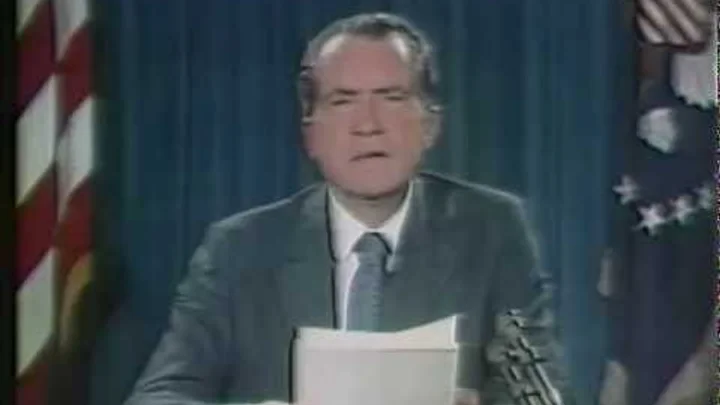
Exactly 55 years ago today, at 9pm on the 15th of August 1971, American households were watching the popular TV show Bonanza on an otherwise typical Sunday evening. Then, suddenly, the show was interrupted by the surprise live-on-air appearance of President Richard Nixon. This was not so uncommon as President Nixon had interrupted American TV before to update the public on matters such as the conduct of the War in Vietnam. This time, however, the matter was different. He was announcing what would arguably become the most consequential change in the post-war world.
He began his address by talking about the fight against inflation, the pressing need for job creation, possible measures of price freezes, and so on and so forth. Important but not colossal. He then proceeded to utter these sentences below, which, it is not an exaggeration to say, blew up the post-World War II stability of the world economies. We are still, in a sense, living the aftershocks of it. And recently, I argue, we have been living through another Nixon Shock, one that is no less consequential. More on that shortly.
In recent weeks, the speculators have been waging an all-out war on the American dollar. The strength of a nation’s currency is based on the strength of that nation’s economy--and the American economy is by far the strongest in the world. Accordingly, I have directed the Secretary of the Treasury to take the action necessary to defend the dollar against the speculators.
I have directed Secretary Connally to suspend temporarily the convertibility of the dollar into gold or other reserve assets, except in amounts and conditions determined to be in the interest of monetary stability and in the best interests of the United States.1
It was a shocking pronouncement of the complete collapse of the Bretton Woods Monetary System. The stability that arose from the Bretton Woods system had rebuilt the devastated world economies, turned former foes like Germany and Japan into industrialised trade partners and allies, and inaugurated an age where middle classes in the Western economies experienced a sustained increase in their real wages that lasted for a generation. Not for nothing that the years from 1945 until 1971 are commonly dubbed the Golden Age of Capitalism or the Trente Glorieuses, the 30 glorious years to refer to it by its continental name. We never had it better. So, what really happened?
What happened in 1971 that could have led to this? August 15th to be exact.

Disclaimer: Be advised that what follows is a gross oversimplification of historical phenomena
The systemic contradictions that dynamited the Bretton-Woods system
When Germany (or what’s left of it) had signed the document of unconditional surrender to the Allies on the 7th of May 1945, the United States was the only country in the world that left the war stronger than it entered. The numbers are indeed crazy. When the war ended, the United States was single-handedly producing half of the world’s output.
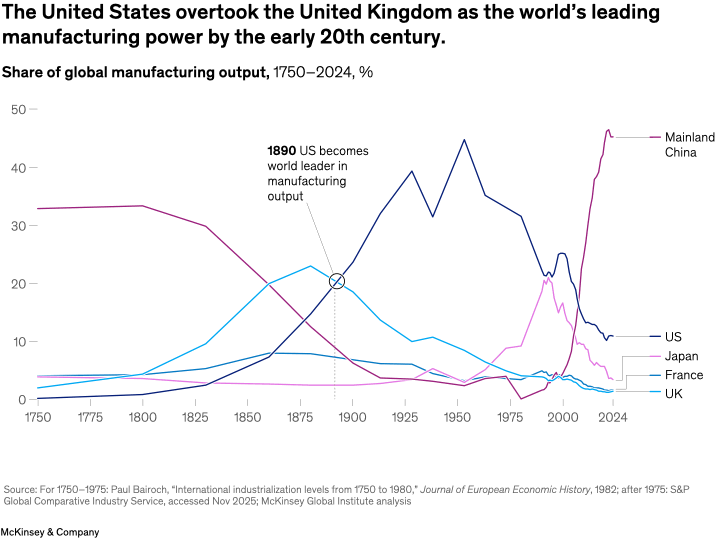
To discuss the implications of this new world with a single undisputed hegemon, delegates from 44 different countries had met the previous year in a village in New Hampshire called Bretton Woods. The main item on the conference agenda was how to ensure stability in this new world with a single economic superpower. There is a whole field of scholarship as to what Bretton-Woods achieved. It suffices to say for now that the most important decisions from the conference were:
The US dollar was tied to gold in value ($35 per ounce). So you could at any point request physical gold from the US in exchange for your dollar reserves.
Other national currencies were pegged to the US dollar for smooth international trade
Creation of the International Monetary Fund (IMF) to monitor exchange rates and assist nations with temporary balance-of-payment deficits.
Creation of the World Bank (IBRD) to provide financial help for post-war reconstruction and economic development.
The Bretton Woods conference aimed at something that was never attempted before: namely, that the international monetary system would be organized around a single national currency, the US Dollar. There was one problem, however: the rest of the world's economies were in a state of devastation, and they held no dollar reserves. There was a shortage of dollars to put it in another way. So how do you make the dollar the world’s reserve currency in a situation like this?
What the US Government had to do was extend its own dollars to the economies rebuilding themselves so that they could use the dollars given to them by the US to purchase goods from the US. The scheme sounds simple enough. To implement it, the US gave its allies 13 billion dollars of official aid under the Marshall Plan. This supplied the allies with the dollars they needed to pay for essential imports. This helped prevent postwar Western Europe from falling back on barter arrangements similar to the scenes from Central Europe during the 1930s. Nobody wanted to even remember the trauma of those days. Now that the Europeans had dollars, they rebuilt their export capacity and, in doing so, accumulated further dollar reserves.
Everything was going well until... well, until everybody won. The Bretton Woods system had achieved precisely what it had set out to do: revive international trade and restore sustained growth to the world economy. But as with most victories, the rewards weren’t enough for the victors. As Germany and Japan industrialized successfully and started selling their goods to an ever-more consuming American middle class, these countries started to accumulate more and more dollars. So what started as a dollar shortage gave way to a dollar glut. These dollars started accumulating in banks outside the US jurisdiction. These banks (particularly the ones in London) were subsequently given the green light to lend these dollars to other actors. Dollar credit creation could now occur outside the United States, in a system that came to be known as the “eurodollar”.
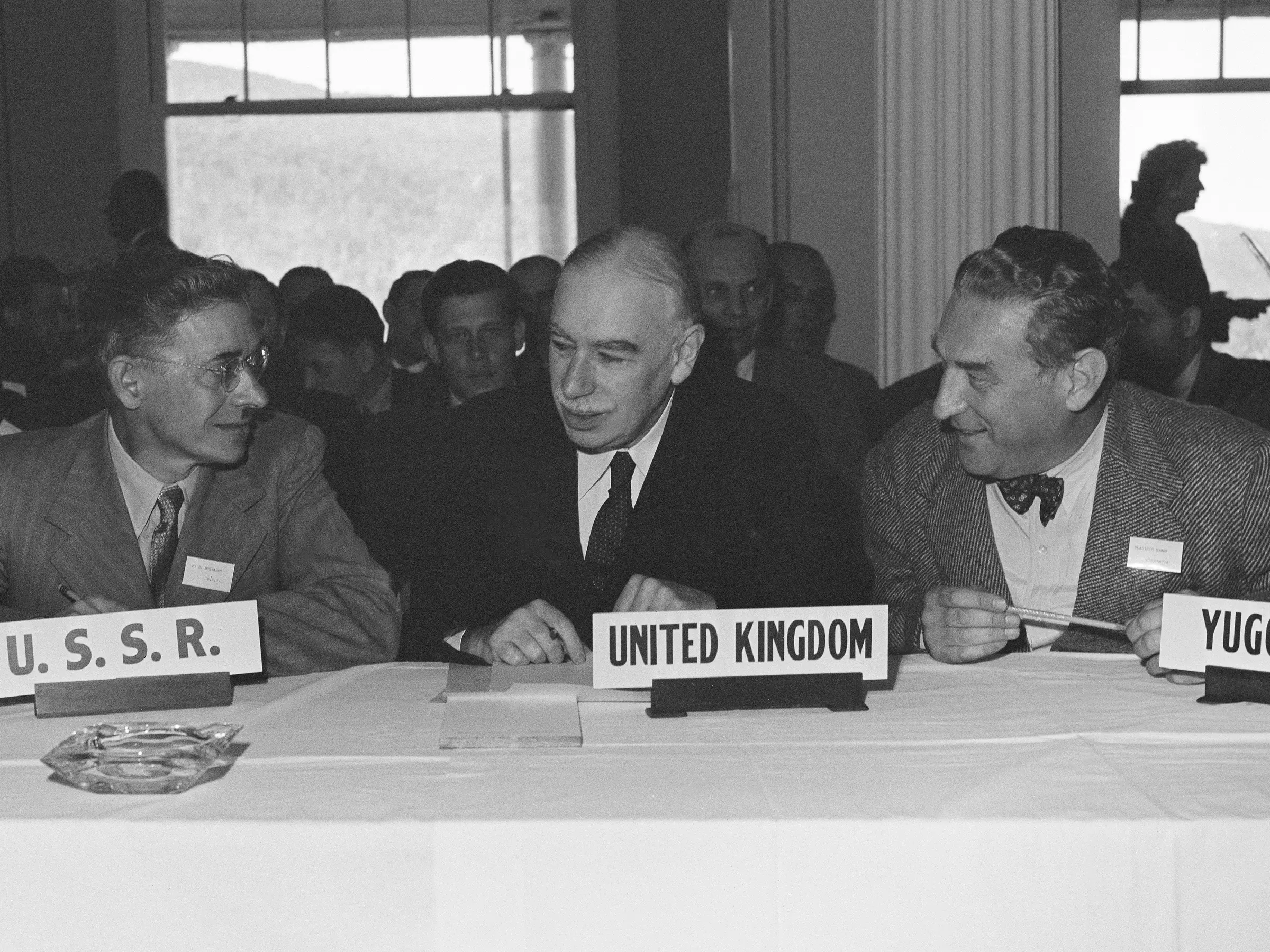
With the advent of the eurodollar, private capital in the US developed an appetite for sending ever more dollar liabilities into the rest of the world. That is, borrowing cheaply from abroad by exploiting the dollar’s reserve-currency status. That cheaply borrowed money could then be deployed wherever capital promised higher returns. The only problem was the Bretton-Woods proviso that was effectively limiting the real size of the pie at 35$ for an ounce of gold. There was a physical limit to how much you could credit the rest of the world. But the appetite of capital, wishing to be unchained, was challenging the foundation of the whole system until it came crashing down, albeit very anticlimactically, on the evening of the 15th of August 1971. When the gold convertibility was abrogated, there was no obstacle left to prevent capitalism from devouring the system it created. In a highly recommended read from Barry Eichengreen in a new book called “Money Beyond Borders: Global Currencies from Croesus to Crypto”, the systemic contradictions leading to the crisis are laid out clearly.
The more immediate threat to the dollar’s international role originated elsewhere, namely in the growing disproportion between the number of dollars in foreign hands and the size of U.S. gold reserves. This point was made by Robert Triffin, a Belgian-American economist who served in virtually every consequential monetary and financial organization of the period Triffin, like Isaah Berlin’s hedgehog, knew one big thing, which he repeated at every turn. Namely, once official foreign dollar holdings exceeded U.S. gold reserves, the fixed dollar price of gold would be in jeopardy. This moment was inevitable, given a growing world economy, a commensurate increase in the need for international liquidity, and inelastic global gold supplies. Eventually, U.S. gold reserves would experience the equivalent of a bank run Governments and central banks, seeking to redeem their dollars for gold at the prevailing price before U.S. gold reserves were exhausted and the cupboard was bare, would rush to present their dollars for conversion. This run would precipitate a massive shift from dollars to gold, like the shift from foreign exchange to gold in 1929–19312
The rest of the world's reservations about this disproportion were also being touted in the lead-up to 1971. Charles de Gaulle was among the European leaders who constantly warned about unrestrained American capital.
Official foreign dollar holdings had just crossed Triffin’s red line, where they exceeded U.S. gold reserves. America’s share of the free world’s gold now tallied just a third, down from two-thirds after World War II. The point was not far off when the dollar’s convertibility into gold at a fixed price would be at risk. In February 1965, French President Charles de Gaulle had held a press conference where he attacked the privileged role of the dollar in the Bretton Woods system, which he saw as allowing American companies to buy up factories and other European assets on the cheap. The not-so-implicit threat was that the French government might liquidate its dollar reserves and, in so doing, ignite a run on U.S. gold stocks by other governments.3
Making your way out of a crisis by changing the definition of what a dollar is
The crisis was resolved only by changing the definition of what a US Dollar meant. Before, one dollar meant one-thirtieth of an ounce of gold. Now one dollar meant… well, just a dollar. After the greenback was finally let go of its chains, financial markets woke up to a very topsy-turvy world on the morning of Monday, 16th August 1971. Now in hindsight, we know that without a doubt, Nixon Shock was a boon for Big Finance.
We now had a world in which the state was effectively turned into a treasury-bond-issuing instrument. The US Treasury became not merely a borrower but a producer of one of the world's essential financial assets: U.S. government debt. The key mechanism functioned thus:
The US Treasury issues new government bonds.
The government deficit widens.
Treasury securities are increasingly used as assets by banks, pension funds, insurers, money-market funds, foreign central banks, hedge funds, you name it.
Treasury securities act as collateral for the global financial system.
Treasury securities serve as a benchmark "risk-free" asset against which other assets are priced.
The US government deficit therefore ends up creating an asset that global capitalism itself needs in a strange feedback loop.
Hedge funds now own 8.5% of the entire Treasury market — more than China, Japan and Saudi Arabia’s official holdings combined. This is dangerous, given how important the US government bond market is to the entire global financial system.

This debt has since ballooned to an unfathomable level of approximately $40 trillion.
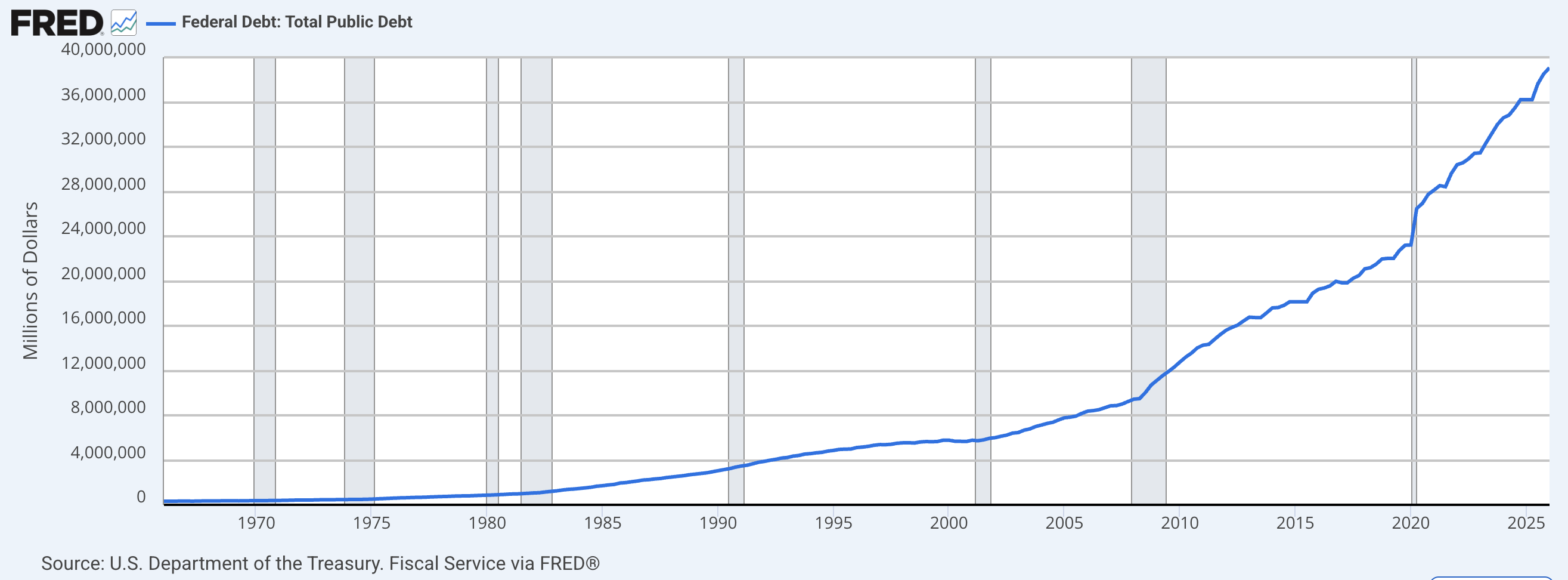
So, how is all this going to end? For the financial wheel to keep turning, the US needs others to keep holding their Treasuries. But what happens if countries want to sell their treasuries when they are in need of liquidity, which is exactly what happened to Japan last week?
Basically what is happening is that the U.S. increasingly needs foreign central banks to keep holding Treasuries even when they need dollar liquidity. In the old model, a country under stress could sell Treasuries to raise dollars and defend its currency. Under fiscal dominance,
Can the show go on? Can the United States manage to keep the reserve currency status of the dollar while avoiding a catastrophe in its bond market? In the past, debacles like this were solved through a deflationary cycle. But the financial sector of the United States has accumulated unprecedented levels of political clout, so this option is automatically ruled out. So is there a panacea? There could be one.
Enter stablecoins
I had been pondering whether there would be a possibility of imposing on the world a redefinition of what a dollar is. And would this operation take the US outside of its current predicament? A potential answer came not in the form of a redefinition of the US dollar á la Nixon, but in the form of a new dollar predicated on the value of the US Dollar. I am, of course, referring to stablecoins.
In May last year, a federal law known as the GENIUS Act was enacted by the Trump administration. The act defines a “payment stablecoin" in federal law. This is something unprecedented. It paves the way for a regulatory framework for a digital asset that the issuer must redeem at a fixed value, intended for payments or settlement, and explicitly not a national currency, bank deposit, or security. So, in effect, a stablecoin is a type of cryptocurrency designed to hold a price that does not fluctuate, pegged 1:1 to the US dollar. As of August 2026, the total value of stablecoins in circulation is above $300 billion. It is predicted to exceed a trillion dollars by the end of the decade. My initial reaction was: why? And why now, to be precise? Could it be the long-awaited Nixon Shock Vol. II salvaging the finances of the US once again?
Let’s take a closer look at how the whole thing works.
Step 1. You give the stablecoin-issuing company (e.g. Tether or Cirle) real dollars
Step 2. The issuing company keeps/invests those dollars. They are legally mandated to keep them invested in very safe, very liquid instruments such as US Treasury bills.
Step 3. The issuing company creates stablecoins for you to use.
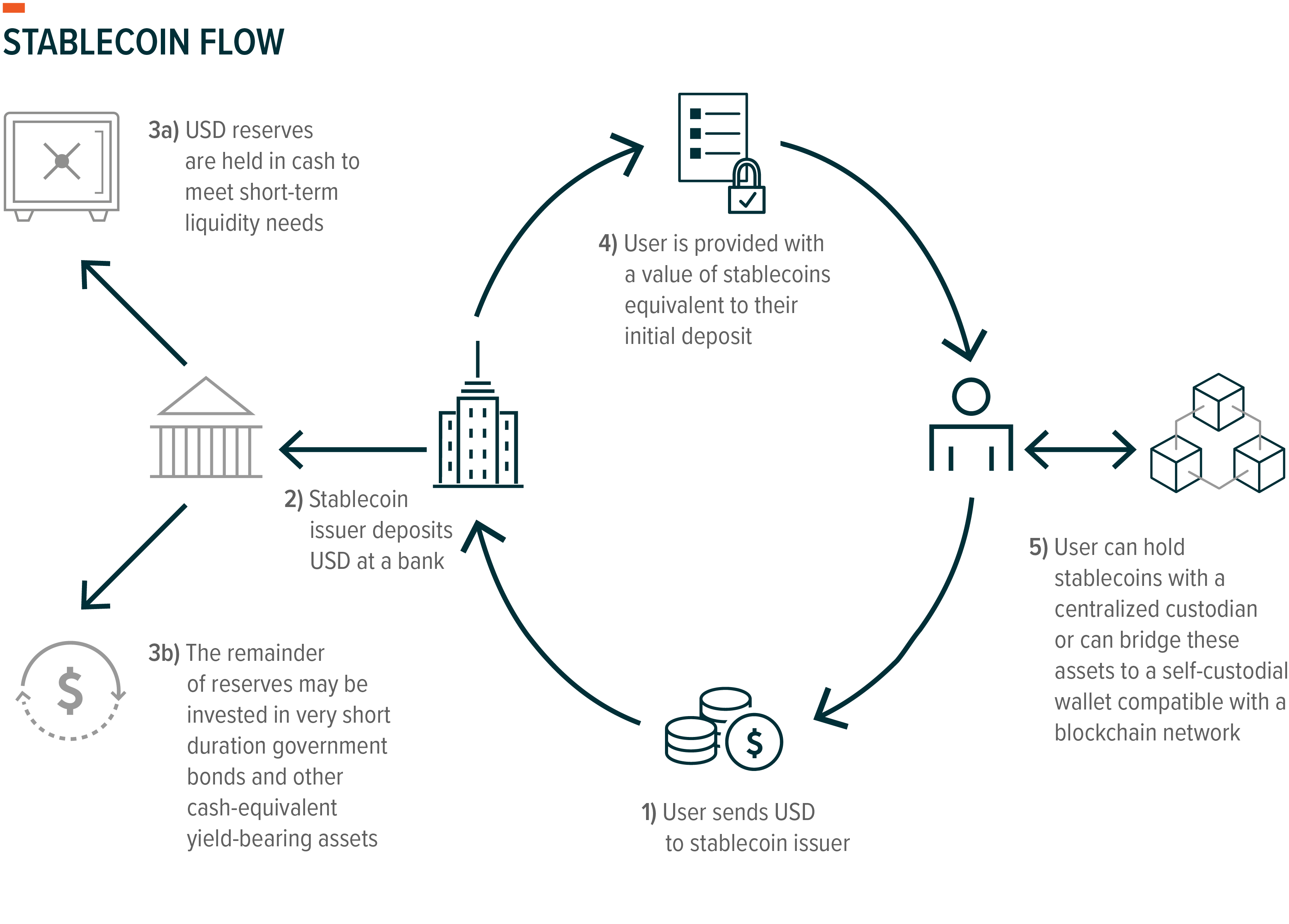
Now, having read the first part, you might have guessed where the potential jackpot lies from the perspective of US financial dominance. Under the GENIUS Act, a permitted payment-stablecoin issuer must maintain reserves at least 1-for-1 against the stablecoins it has issued. From a political-economic lens, US Treasury bills are the most attractive choice for this reserve asset. Because they are highly liquid and pay interest, whereas holding them in cash generally doesn’t. For the sake of the argument, imagine you are a certain individual from Argentina buying stablecoins. You have the option to obtain a tokenized asset linked in value to the US dollar while bypassing much of the traditional financial architecture. One can name the need to hold a US bank account or physical dollars, use Fedwire or Western Union, maintain a local dollar deposit, you name it. And because of the demand to create more stablecoins, the issuer companies would accumulate more US Treasury bills. Theoretically, you have now transformed every individual on the planet with access to stablecoins into a potential financier of the US Treasury. Dollar demand that once had to pass through banks, governments, and central banks can increasingly be channeled through a decentralized digital infrastructure. That is a historic development with potentially monumental consequences. If, through the adoption of a stablecoin framework, the US has a systemic downward pull on its treasury yields, is that not a way out of the predicament at hand? By redefining the dollar as something that is one-to-one pegged to a digital coin, did the US once again manage to defer the reckoning on its obligations? What is really ironic is this: could the revolutionary technology that is blockchain, which has risen to prominence challenging the fiat currency architecture, eventually be used as its ultimate defender?
Now, to be really speculative, imagine that years from now people routinely write contracts with stablecoins. Imagine the pricing of goods, payment of taxes and salaries, mortgage contracts, hedging contracts, all denominated in stablecoins. At that point, could one not easily imagine another Nixon announcing the severing of the link between one stablecoin dollar and one Federal Reserve dollar? You would effectively transition from sovereign fiat money into a completely new monetary architecture.
What is not speculative, however, is that the way forward is more uncertain than ever.
Eichengreen, B. (2026). Money beyond borders: Global currencies from Croesus to crypto. Princeton University Press, p.140
Eichengreen, B. (2026). Money beyond borders: Global currencies from Croesus to crypto. Princeton University Press. p.143