What is a GPU and why is it suddenly at the center of geopolitical rivalries
If you were like me, who grew up playing computer games, you might be forgiven for nostalgically reminiscing about the hours spent playing Quake or Half-Life everytime you see the NVIDIA logo on the news. For how could I have known that by pleading with my family to get me a NVIDIA graphics chip for my birthday so that I have better explosion visuals in my video games, I was actually funding the advent of the greatest invention of our times. That is of course AI.
This is not a technical piece so I will spare the minutiae as to how thanks to a (partly) historical accident the Graphics Processing Units that NVIDIA was so good at producing were discovered to be the material best poised to power the incoming AI boom. For the non-technical reader, suffice to say that the biggest discovery that powered the AI revolution was this realization: That to train and fine-tune the AI models which we call LLMs, you need machines that are able to power billions of matrix multiplications. These operations, in simple terms, refer to transposing the human language into numerical coordinates and making the machine go through trillions of text data to reproduce accurately the human language. And coincidentally, the graphics chips produced by NVIDIA were doing just that. The caveat was that they were doing that for the video game screens which simultaneously do these matrix operations on millions of pixels. Once NVIDIA developed the software that allowed this potential computational firepower to be applied for general purposes and not just to video games, you had the ideal tech stack for training AI. And the rest is history.
After it was discovered that these GPUs were the bread and butter of the incoming AI age, the transformation of these commodities from being a gamer’s dream into a key asset coveted by all the great powers happened pretty quickly. The precarious global hegemon USA was quick to recognize that locking in its head-start on AI was crucial to maintaining its global hegemon status. The aspirant great power China on the other hand, was also quick to recognize that winning the AI-race was tantamount to dethroning the US from the global sovereignty it was so accustomed to exercise. Not coincidentally, the political dynamics and the attendant supply chain maneuvers are very much rhyming with the nuclear arms race of the Cold War era. The analogies abound.
So how does the Futures Market for Compute fit into this picture?
For some time now, I have been following enthusiastically the advances towards the development of a financial market for GPU compute. It would not be an understatement to say that it has the potential to be among the most significant financial leaps of the decade. The momentousness of this perhaps warrants another piece. At the center of this is Carmen Li. She is simultaneously the CEO of two stellar, and also complementary, companies. These two companies are Silicon Data and Compute Exchange. They jointly form the two pillars in forming a futures market for GPUs. Let us now delve into how they are bringing about the infrastructure for standardized GPU futures markets.
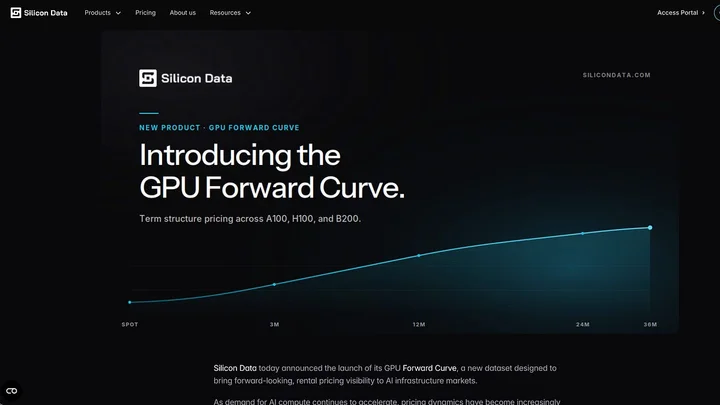
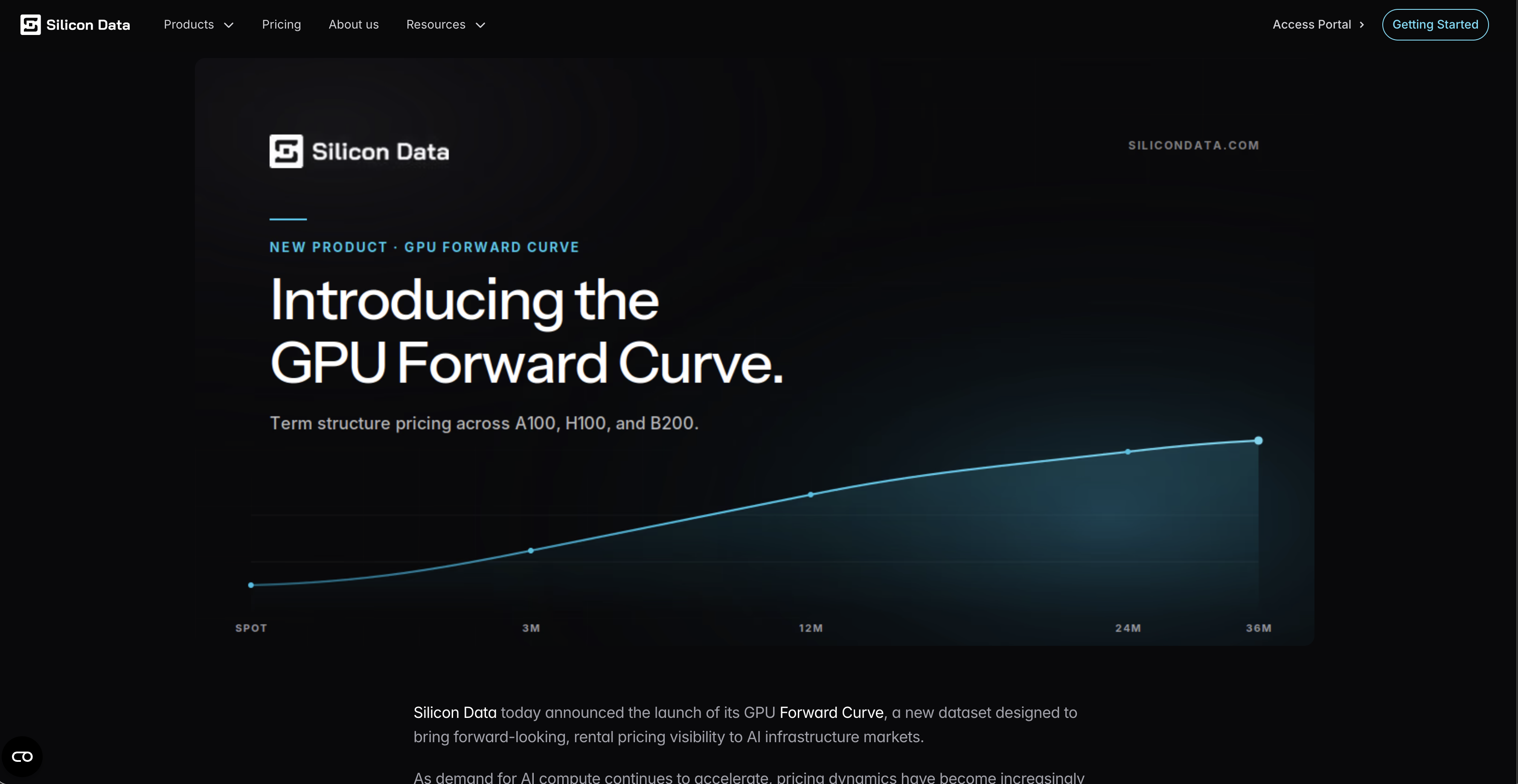
Silicon Data is the first part of the piece. While the name of this company does not dominate the headlines as much as the other household names when it comes to AI, it is quietly designing the solutions that seek to solve the bottleneck to plug AI supply chain into the financial exchanges. You can think of it like a Bloomberg for all things chips. Think of the benchmarking functions Bloomberg does for other securities applied for the security that would be AI compute. It tracks the costs to rent GPUs like NVIDIA A100, H100, B200, etc., across providers and regions. It then standardizes it into an index á la S&P . Its GPU Index gives daily standardized rental-price data and historical time series for procurement, investment, and cloud-cost benchmarking. So the implication of all this is that, you end up with AI compute looking a lot like any other tradable commodity on the market. Complete with all the GPU forward curves that would revolutionize the GPU rental pricing over a 36-month horizon.
Carmen Li says on Tuesday’s Bloomberg Odd Lots Podcast, which I encourage everyone to go listen, that the whole thing is ready and is waiting on regulatory approval.
We now come to the second piece of the puzzle that is the would-be actual marketplace: Compute Exchange. Having developed the standardized benchmarks thanks to Silicon Data you now have a market place to trade in. To help with the comprehension of the whole thing, you can imagine Silicon Data as providing an index like the S&P 500. This then leads to the creation of financial products whose values are linked to the S&P 500 index such as ETFs like SPY or CME S&P 500 futures and so on and so forth. The place where these products are traded are the exchanges such as the New York Stock Exchange (NYSE) or the CME. In this analogy the function of these exchanges are exactly what Compute Exchange does. As with any market-maker it brings together a seller willing to sell with a buyer willing to buy.
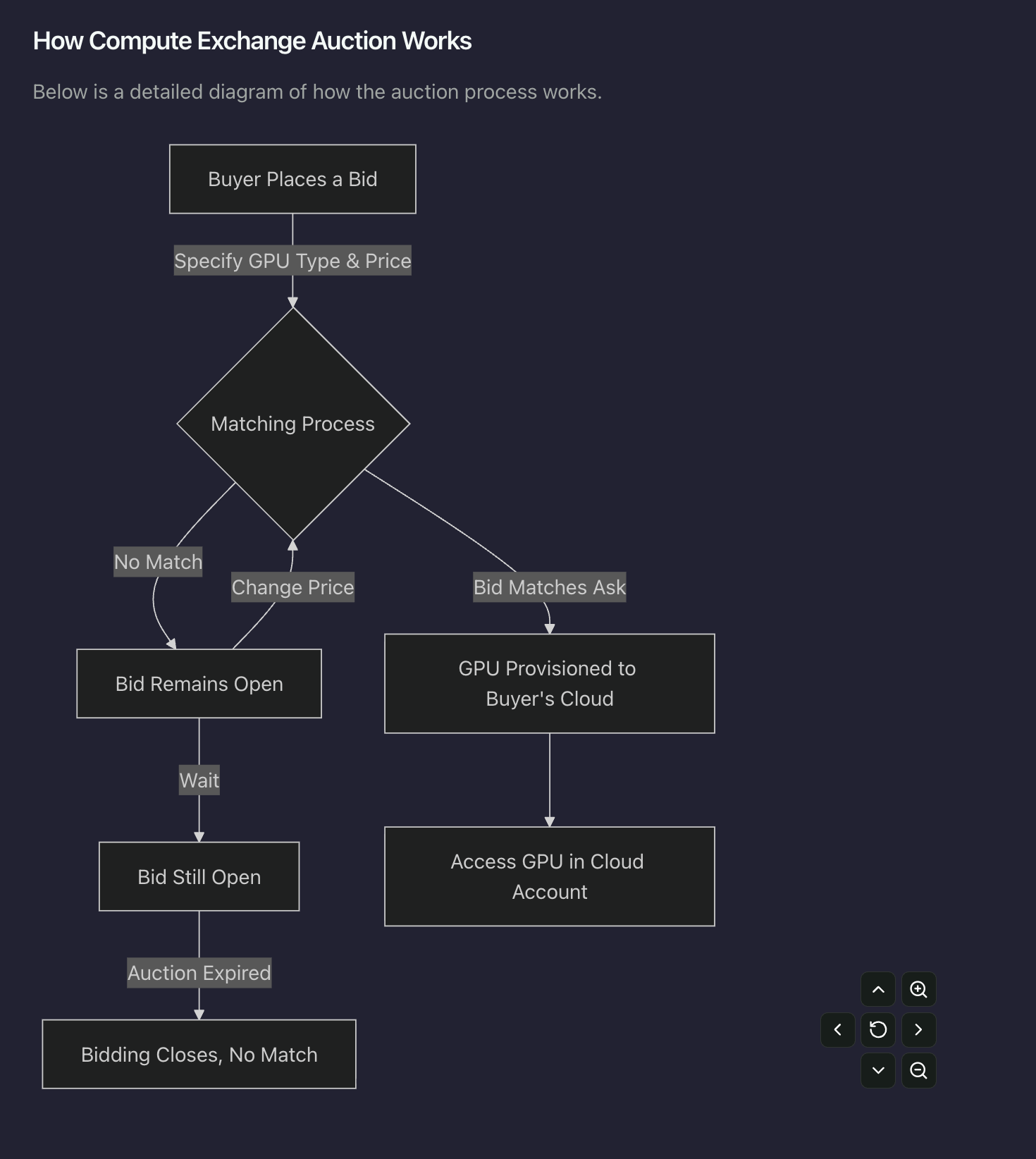
Think for a moment of the implications of this. You have on the horizon the prospect of turning the problem of AI compute from an obscure procurement procedure with opaque layers into a real market. Which means you also have the opportunity to hedge away the volatility around AI compute. Imagine you are a potential entrant into the AI landscape and being able to hedge away some of the questions like the following.
“Should I buy GPUs, should I rent GPUs, or how much exposure should I hedge?”
“How exposed I am to compute inflation?”
“Would fluctuating electricity prices kill my AI startup?”
“Are the B200 chips currently overpriced relative to H100s?
You can add lots and lots more obviously.
The optionality that follows with the introduction of hedging, as you can imagine, is critical for equal market access. You would in practice turn an opaque market controlled by cartel like oligopolies e.g. Google, Microsoft, Amazon, Meta who are massively capitalized, into a more level playing field. Although I acknowledge that it can easily go either way with deep-pocketed players dominating the hedging. There’s a lot more to be said on the matter but I leave that to another piece. For now consider this hefty introduction over for the main case for the futures markets for AI compute, I believe, is more geopolitical than financial.
The Geopolitical case for the GPU future market
Let’s switch our gaze to another volatile commodity world runs on (quite literally). That is of course oil. The war on Iran and the subsequent closure of the Straits of Hormuz, where one fifth of the worlds oil was being shipped out to the world has sent the volatility of the price of a barrel of oil through the roof. Add to that the damage on the infrastructure of the refineries and equipment which further complicates predictability in the supply chain. If we adopt a longue durée perspective the phenomenon is not a new one. As industry veterans like Jeff Currie have been pointing out , oil price fluctuations following a conflict in the Middle East have been a perennial issue. The word perennial carries a lot of weight here. It will be quite evident if we look at the history of modern oil hedging complex.
One of the most interesting things I have learned over the duration of this conflict was the fact that the oil hedging system of today owed its existence to the oil price shocks of the 70s.1 Most notably the OPEC embargo of 1973 and the shock following the Iranian Revolution in 1979. Both were geopolitical shocks to their core. It is thanks to the disruptions caused by these geopolitical shocks affecting the supply chain to such a devastating effect that the modern hedging system came about.
In the early 70s the world economy was highly dependent on oil. Almost the whole economic system depended on the cheap procurement of oil. Everything from cars, suburbs, petrochemicals, air travel, trucking, mechanized agriculture and oil-fired power generation. And oil, despite being the commodity that the world ran on was priced mostly through long-term contracts, posted prices, major oil company control, and producer-state pricing. This was all appropriate for a stable and predictable world order. However, this all changed one October in 1973 when the OPEC oil producers discovered they could weaponize their oil production quantity to punish the Western powers for their support for Israel during the Yom-Kippur War. Opec countries discovering they could flex oil production as a tour de force in a state of exception during a period of conflict is really reminiscent of Iran realizing it can use the access in and out of the Hurmuz Strait as a bargaining chip isn’t it?
The result of all this was a quadrupling of oil prices which, it won’t be an understatement to say, redesigned the world order. There have been countless books and studies of the event so I will leave it there. Now, for the sake of my argument consider this counter-factual scenario: What if the hedging system was already in place during the early 70s? If the Western economies were already operating in an economy replete with contracts like oil futures which hedge their risk, the OPEC Countries would have a lot less firepower in constraining production. This is simple game theory. (You can actually model this as a game and solve it via backward induction.) If you know your opponent would be less affected by the consequence of your action you have less of an incentive to exercise it. Of course, in the scenario of a total blockade of a supply line your hedging contract is useless but it is still a risk buffer from a firms’ perspective nevertheless.
You might have guessed where I am going with this geopolitical turn. AI compute is arguably the most geo-strategically important commodity of our times. And one company in Taiwan sits at the center of all this. Taiwan Semiconductor Manufacturing Company (TSMC). This company is the central node within the AI supply chain. This company is the one unique company in the world that is able to produce the actual physical silicon that powers the whole thing. And there is just no viable alternative around it! And it is located on an island that is at the epicenter of the great power rivalry, or the Cold War vol.II as a lot of commentators choose to term it. Increasingly it is proving to be the place where the cold war could turn into a hot war. Increasingly, the scenario where China blockades Taiwan, thus blocking the supply of these chips, is being discussed. Not least in policy centers. Geopolitically, from China’s perspective, the credible threat to cut-off the supply of TSMC is a major bargaining chip. The threat of the said blockade hangs like a Damocles’ Sword on the head of the incumbent global hegemon.
Now imagine if we had a world where AI compute was successfully hedged by parties operating in the AI landscape, would that not decrease the gravity of the threat of a possible blockade? It would convert the abstract potential shock into a priced, tradable, and hedgeable risk. It is also evident that in the case of a blockade when output is essentially zero the hedging contracts are also meaningless. But the point here is that a credible threat, without an attendant action, would have less of a hold on the AI economy in this scenario. Hence from a game theory perspective renders the option less attractive from a Chinese point. I claim it is here the strength of the argument lies; that financial market infrastructure could be intervowen to the geopolitical architecture of AI to net global benefit. If the destructive impact of two oil shocks necessitated the hedging system for oil, why wait for an equivalent shock to implement the same as regards the AI supply chain. Maybe there is a lesson there. That precisely, is the case for the futures market for GPUs.
Intercontinental Exchange, 2009. ICE crude oil [Brochure]