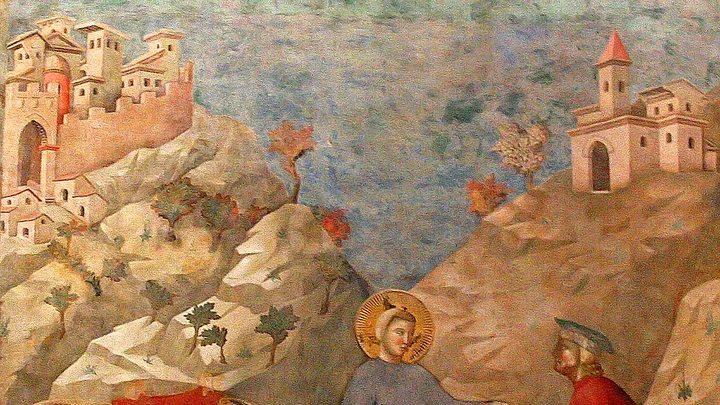
We sometimes tend to forget that the enterprise of the “Interpretation of Dreams” did not start with Dr. Freud. Nor was its typical subject a Fin-de-siècle Viennese bourgeois.
In our post-industrial, post-Freudian societies we seem to have forgotten that dreams were never wholly about the individuals that dreamt them. Instead, what the patient dreamt about concerned the whole polity. Dreams had their own political theology, to borrow the term from Carl Schmitt.
The jurist/political philosopher wrote his Politische Theologie in the year 1922. The canonical formulation of what he means by the term, although grossly oversimplified, would be:
All significant concepts of the modern theory of the state are secularized theological concepts.
The implications of this formulation were ominous for the already ill-fated Weimar Republic, the first attempt at a liberal democracy in Germany. If one follows Schmitt’s argumentation closely, it becomes obvious that modern political concepts did not simply appear ex nihilo once Europe became “secular”. Ergo, a seemingly secular polity run by a liberal constitution appears, in this light, as a transformation of older theological concepts.
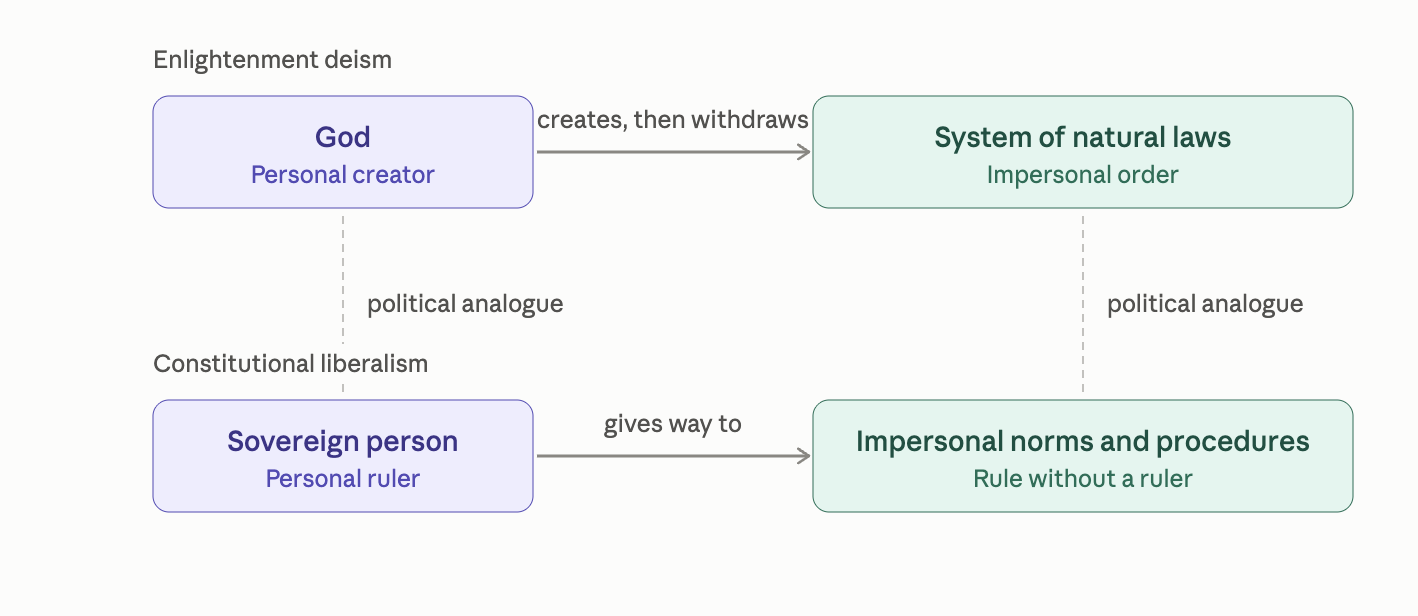
In the tradition of classical theology, which was highly developed in Europe, God gives rise to the causal order of nature but is not exhausted by it. The miracle represents precisely an interruption of this normal causal order from beyond it. Enlightenment deism, by contrast, increasingly imagines God as the creator who establishes this causal order and then withdraws from it. Because according to Schmitt affinity between a society's metaphysical image of the world and its political-juridical form is inevitable. The transformation of God from the creator to overseer, for Schmitt, is mirrored in politics: the sovereign person gives way to an impersonal order of norms and procedures.
This theological intellectual/juridical heritage is what leads Schmitt to arrive at his famous definition of sovereignty:
“Sovereign is he who decides on the exception.”
What makes this formulation potentially threatening to the claim to legitimacy of the liberal constitutional order is precisely this: even where we moderns dispense with God in the founding legal texts of the new polities we form, the formal structures once occupied by theological concepts survive.
What happens, and it is bound to happen, when the applicability of the entire normative system itself becomes uncertain? In that moment the true nature of an order becomes visible. Not in normal circumstances, but in the moment when the normal rules fail.
There needs to be a decision-maker who declares a state of exception until order can be restored.
The logical conclusion is that: Every juridical order ultimately rests upon something it cannot completely juridicize. There is no final norm, no ultimate signifier within the juridical system, from which the whole thing can simply emanate.
Now back to dreams. The Schmittian overture was necessary so that this analogy becomes intelligible:
What if we conceptualize the dream as the epistemic state of exception?
It is not coincidental that there exists an enigmatic dream in the foundation stories of so many of the greatest empires ever founded. Before political/institutional knowledge emerges through the ordinary channels known to us, like counsel, law, deliberation, inheritance, military intelligence etc., the to-be-sovereign dreams.
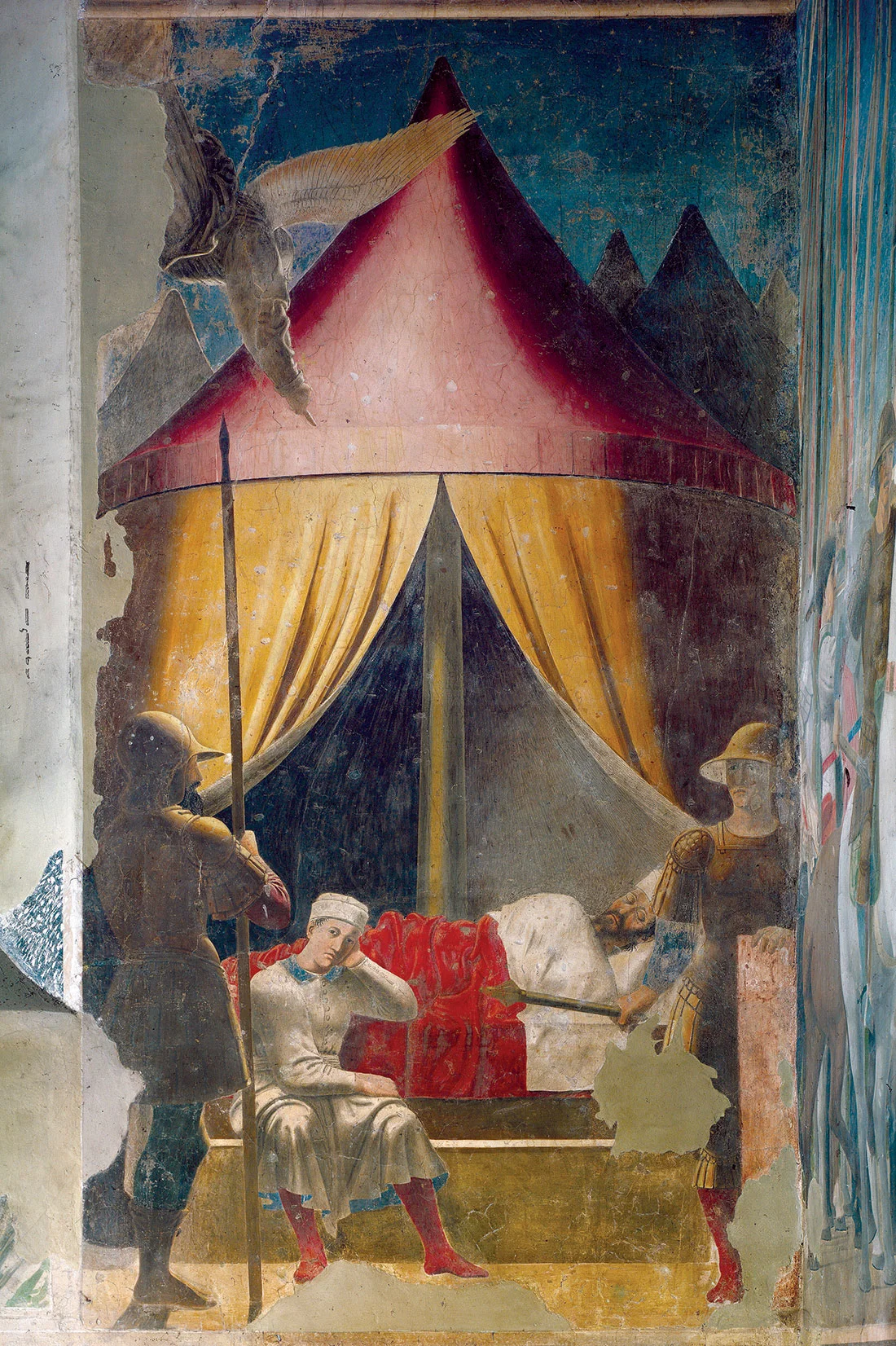
Eusebius recounts that, on the eve of his battle with Maxentius, Constantine first sees the Cross in the sky and later Christ appears to him in sleep and instructs him to use the sign militarily. This epistemic state of exception afterwards perhaps becomes the foundational myth of Christian Roman imperial rule.
Or, to look at the foundation myth of another of the most illustrious empires ever founded: the Ottoman Empire. According to chroniclers, when Osman, the founder of the Empire, was staying at the home of the religious leader Sheikh Edebali, he experienced a vivid vision in his sleep. Osman saw an enormous tree growing from within himself, whose shade covered the world. The sheikh interpreted this as divine confirmation that sovereignty would belong to Osman and his descendants.
Once again, an epistemic state of exception turns into a foundational myth of an entire imperial order.
And perhaps the most foundational of all are Nebuchadnezzar’s dreams interpreted by Daniel. The dreams Daniel interprets place God’s eternal kingdom against the temporal order of earthly kingdoms.
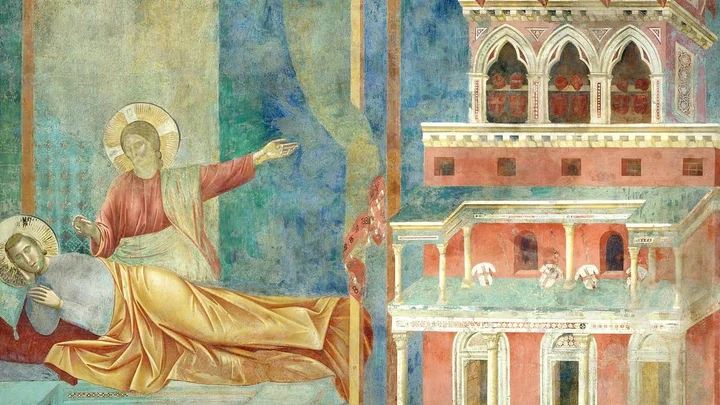
We are now back at the Upper Basilica in Assisi. The third fresco in the Giotto cycle is the dream of the palace. According to Bonaventure, after Francis gives his mantle to the impoverished knight, he falls asleep and a magnificent palace, filled with arms bearing the sign of the Cross, appears before him.
In this world where dreams have a political theology of their own, what does it all mean?
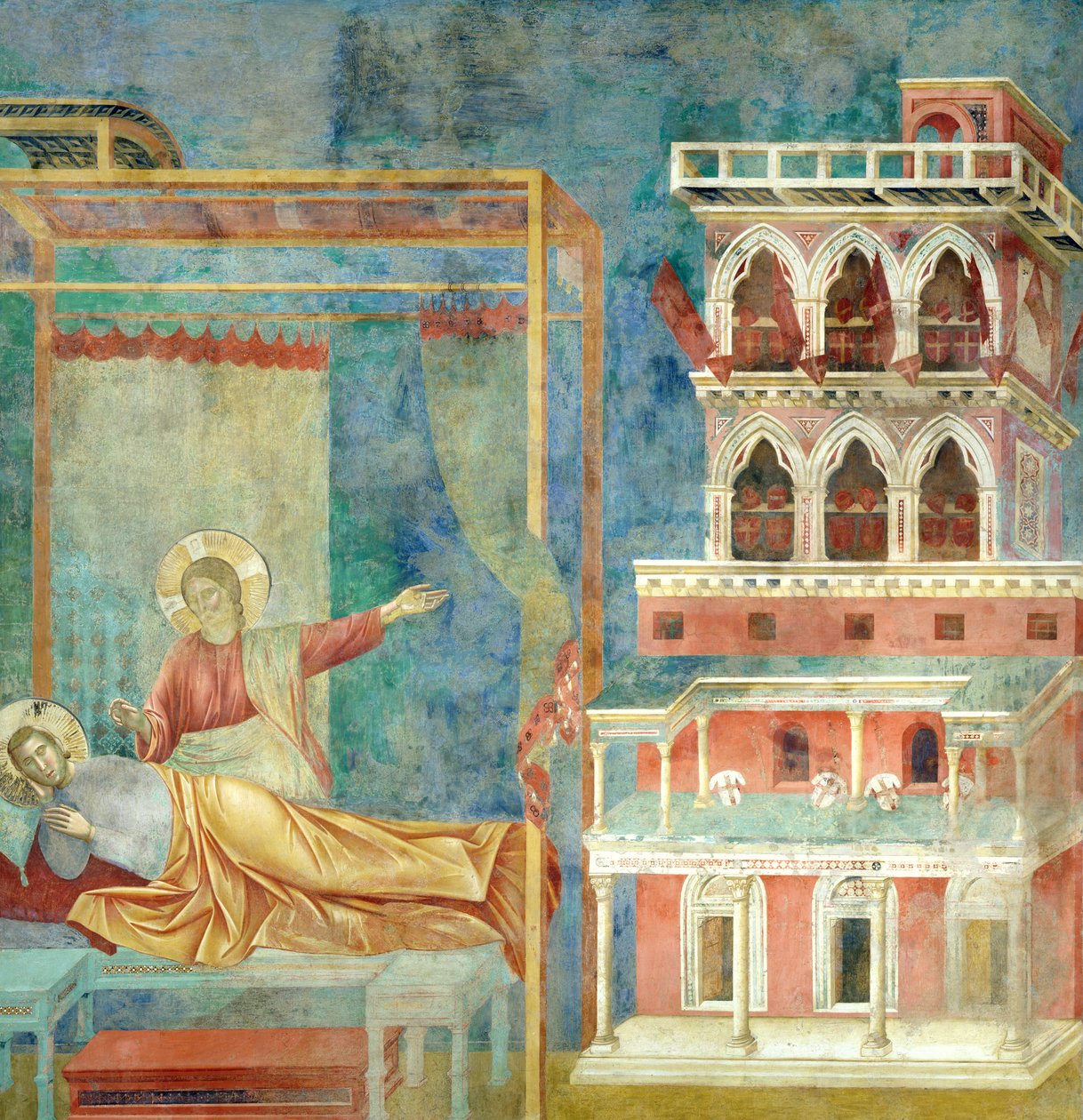
Last week, we explored how Francis brought forth a new consciousness through the Great Refusal, opening up the possibility of a new way of being. Yet when this new world is pointed to him in a dream, it appears in the vocabulary of the old world.
The world of palaces, armour, lordship and soldiers and glory and… all the morbid symptoms of the old manifest themselves.
Francis dreams of transcendence.
In a medieval society, however, transcendence for a wool merchant’s son would be to obtain lordship and to occupy the tower. The transcendence thus appears to him within the imaginary order of the past.
This epistemic state of exception revealed to Francis, however, is of a completely different order. It is to be the foundation not of a new polity or an empire, but of a new historical consciousness birthed from an interregnum.
The old imagery is negated and preserved at once, sublated into a new form of consciousness. This is Hegelian Aufhebung operating at the level of the political theology of dreams.
Constantine dreamed the Cross and marched victorious toward Rome. Osman dreamed the tree, and his descendants came to imagine an empire beneath its shade. Francis dreamed a palace filled with arms bearing the Cross.
Yet Francis’s dream pertains to an altogether different political theology.
In Constantine and Osman, the dream consecrates sovereignty over a polity. In Francis, sovereignty is displaced: from dominion over an external order to the subject’s capacity to negate the world as given and bring forth another way of being.
The sovereignty that Francis’s dream engendered is the sovereignty of the modern subject.