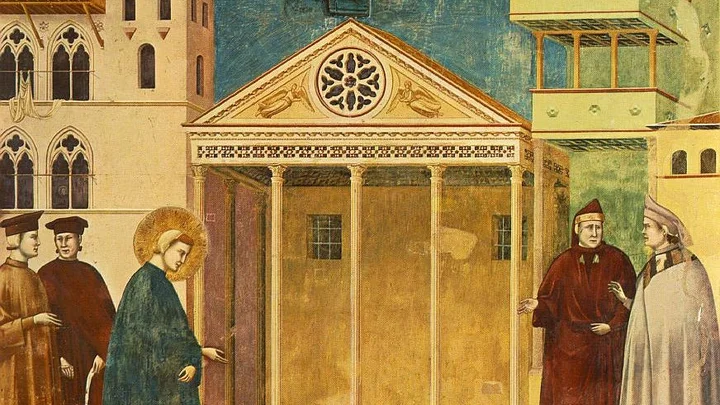
Your eyes take some time to adjust. You find it weird that you kept looking at a fresco for so long. The dim candlelight. The strong incense coming from the altar. The bodies crossing. The smell of damp wool and sweat is not enough to take your attention away from the simple man. And yet the mass is about to start. You bring yourself to walk along the nave to take your place. The image of the simple man just doesn’t leave your head. As you take a few steps along the nave, you see the fresco that is adjacent to the one you were just looking at:
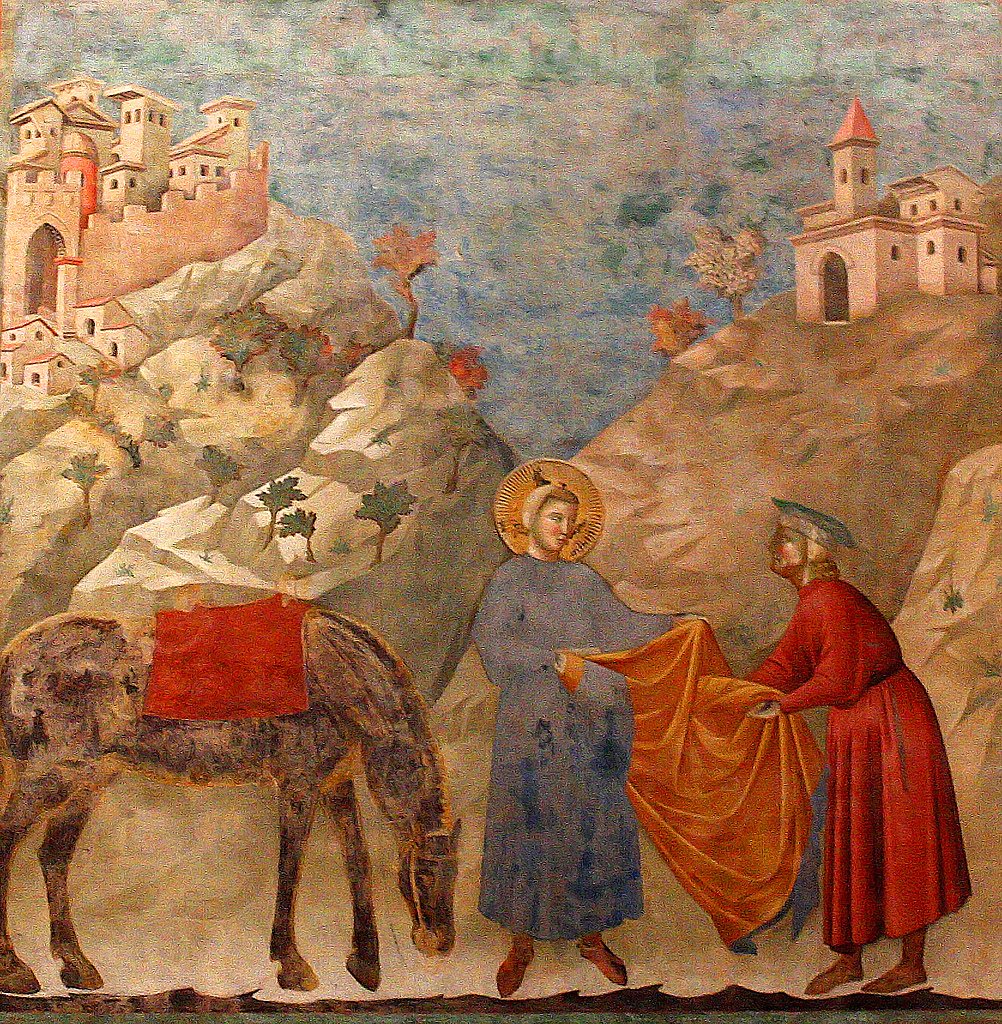
Again, the scenery is familiar to you. It is, after all, where you grew up. On the left is Assisi and on the right the Benedictine Abbey of San Benedetto al Subasio. Still, it is strange to see the places you have wandered through all your life as the center of a holy scene. On a closer look, things get even more puzzling.
Between the sacred and the sovereign
Between the city, that is the realm of the secular/the sovereign, and the abbey, the sacred, stands Francis, the son of the cloth merchant Pietro di Bernardone. Yet he apparently belongs to neither the sacred nor the sovereign. Francis of Assisi. The heir to a booming transalpine business. He could have been one of the richest people that ever roamed these little towns. He could have sponsored popes or, even better, bankrolled the mercenary armies that fought the wars that decided the fate of popes in 13th-century Italy.
And yet, he takes off his exquisite piece of cloth to give it to the poor knight, apparently asking for nothing in return. Cloth. That is the item that is at the center of the whole symbolic order of this new world. The story of the commodity, cloth, is the story of the rapidly growing urban economy. It is the commodity that is perhaps responsible for bringing about this commercial revolution. Francis is taking the objects produced by that revolution and placing them inside another economy altogether.
But you should make no mistake. Giving away the garment is not charity. It is something else entirely. This symbolic gesture marks the birth of an entirely new and radical form of consciousness.
The consciousness that arises out of a great refusal. This refusal to accept this newly wrought social order as the necessary form of human existence. In this sense, it is exactly the Great Refusal as Herbert Marcuse formulated it! By giving away his cloth garment, Francis asserts a radically new form of freedom. This freedom is engendered by refusing to identify with the actual conditions of the world. It is the great refusal to act in accordance with mercantile motives, to obey thy father, to act according to market logic, you name it.
This refusal is the basis of a radical new ethics. An ethic that does not come from philosophizing. It is lived. It is felt. It is embodied. Precisely because of this, it is the strongest categorial rejection of Marcuse's conception of man as one-dimensional. Herbert Marcuse, in his magnum opus published in 1964, One-Dimensional Man, argues that the social world has lost the effective tension between what exists and what could exist otherwise. The “negative thinking,” if you like. This lost “second dimension” is the dimension of negation, transcendence, contradiction, and alternative possibility.
Francis rejects man’s loss of the “second dimension” at the outset. His giving the cloth symbolizes the possibility of the critical distance between how human beings exist and how human beings might exist under emancipated conditions. This negation of the existing order in order to raise man to a higher/sublated level of consciousness is Hegelian Aufhebung in its most crystallized, simple form. It is the ultimate expression of the capacity of consciousness to transcend what is given.
When Marcuse was writing One-Dimensional Man, he had in mind all those excesses of the advanced industrial society. The consumption, the entertainment, sexual permissiveness, technological convenience, career choice, travel, commodities, endless cultural production and the injunction to ever consume more. I speculate that if you follow this thread of critique far enough back to its provenance, you arrive at Francis’ piece of cloth.
And now, in these unprecedented times, when the social fabric disintegrates with utmost speed, as new forms of “Technik” interpenetrate daily life, the yearning for an emancipatory Great Refusal is graver than ever. Seen in this light, theological thinking occupying an ever greater space in our psyches begins to appear less as a historical anomaly. It is not an aberration. Far from it. It is a historically intelligible response to a societal rupture.
The chanting that starts from beyond the altar snaps you out of the spell the fresco has cast on you. The Easter mass is starting. You and everyone else in the basilica who has been looking at the frescoes of Giotto feel that you are indeed partaking in a Resurrection.