You are living through times of change at an unfathomable speed. The world you were born into does not exist anymore. It used to be a world in which who you are was overwhelmingly assigned to you. It was a static world. And a comfortable one, perhaps precisely because of that. All that, however, changed so dramatically, so rapidly.
You are an inhabitant of a small town in Central Italy called Assisi at the turn of the 14th century. As you are about to enter the newly decorated huge basilica on the western edge of town for the Easter Mass, you feel the unbearable lightness of this question weighing on you:
If my position in the world is no longer simply given to me, then who am I supposed to be?
The Church no longer seems to have an answer to your question. The priest behind the altar inside is equally lost. Nobody knows what to feel or what to think now that the old social and spiritual synthesis that glued the whole society together no longer holds.
In this new world that you’ve sleepwalked into1, you no longer see the familiar faces you used to see inside the cathedrals. It is no longer the lords in armor in the first row, followed by the bishop and his clergyman, then the jurists and officials, then the peasants and the folk and maybe some landless poor. That used to be all. But now there are some unrecognizable people in there. They wear colorful garments made of cloth. They walk around with big account books. They talk differently. The poor of the countryside, newly arriving in towns, flock around them in search of work. They talk about credit and commercial contracts and capital invested and sometimes you hear them whispering about interest. This all feels so uncanny to you who have sleepwalked into this world of what Robert Lopez termed The Commercial Revolution.
You now have a new world in which money is becoming not merely a medium of exchange but a new way of measuring, comparing, and organizing the world. You just don’t know it yet.
But then again the basilica you are about to walk into is not just any basilica. For as you walk through the door and begin treading the nave, you look to your right and you see this on the wall staring back at you:
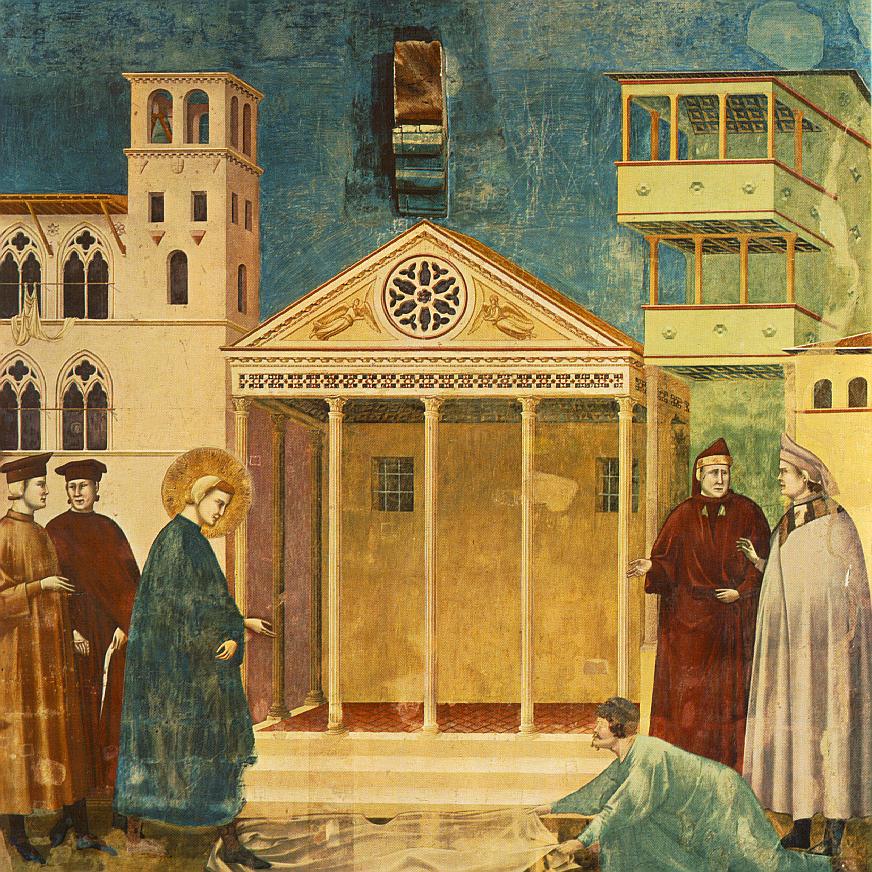
You can’t take your eyes off it. Something feels strange to you. The frescoes look eerily real. You recognize your city behind the figures. You are not used to seeing the sacred rendered so real, so close to you. This is not the flat, timeless world of the images you grew up seeing in churches. For you used to see panels like this one below. Those figures seemed simply to float there in a timeless vacuum. Detached.
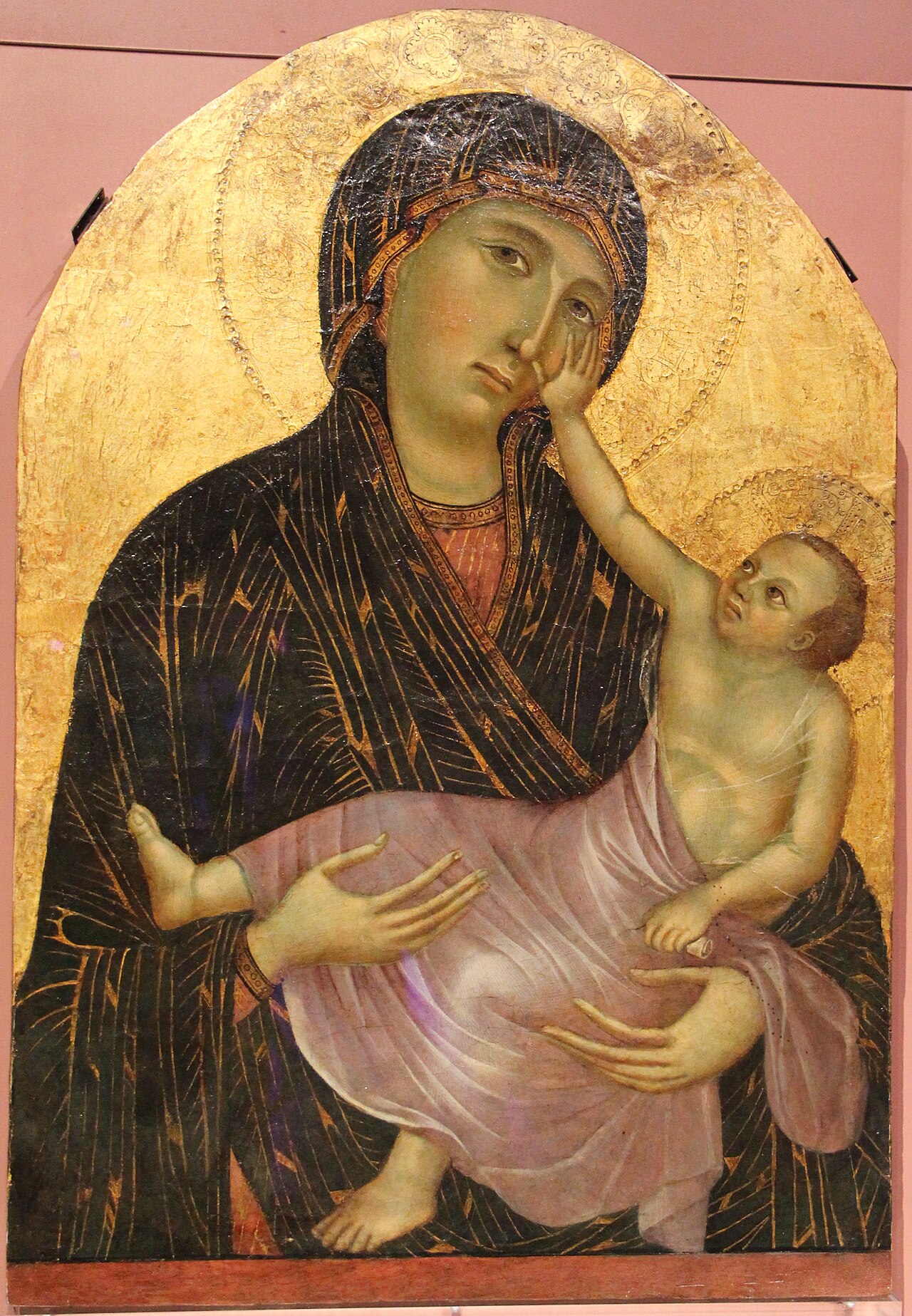
Something definitely changed. The sacred definitely has entered lived human space. The scene in the fresco you are admiring, simple folk laying garments before an ostensibly sacred person, is familiar to you from the New Testament depictions you grew up with. When Christ was entering Jerusalem, people spread their garments beneath his feet.
But this man is not Christ.
He was called Giovanni di Pietro di Bernardone. He was the son of a cloth merchant. His father would call him Francis, meaning Frenchman. Plausibly because France brought him a lot of commercial success. There is perhaps something telling in naming your son after the source of your commercial success. Maybe that tells you all you need to know about this new class of people: the colorful-garment-wearing, account-book-carrying parvenus you keep seeing more of.
But why was Francis getting the treatment Christ received before the gates of Jerusalem. This simple man seemed to have recognized something transcendent in him. But Francis had not become that man yet.
He could have become a successful merchant like his father. A knight. A courtly gentleman. Successful burgher and a financier. He could accumulate capital. Travel. Aspire. Reinvent himself.
You see, he felt a similar weight of the question bugging you.
The market asked him:
What have you acquired?
The new social hierarchy of the parvenus asked him:
What rank do you possess?
The old nobility resented him:
You are not one of us
But the gaze of the simple man laying down the garment asks something altogether different:
What have you been called to become?
And there, from the fresco, stares back at us the fundamental question that has haunted us ever since: The disjunction between socially assigned identity and the self that might yet be constituted. There lies, in that eternal moment in the fresco, the kernel of the ultimate Hegelian subject. Selfhood begins to emerge through another consciousness recognizing something in me that I cannot yet recognize in myself. The person telling Francis that he is simply not Francis is not Francis himself. And it is a Godly moment. It is Christomorphic. It also prefigures Hegel by six centuries. Perhaps introducing a backward teleology into Hegel’s forward-flowing History is helpful…
In due course, I hope to demonstrate, through scenes from the Saint’s life, how the life Francis lived answered the question of what/how to become so sublimely that it reverberates into our own time, perhaps with more immediacy than ever.
It is also my aim to render legible to my readers how a changing material world made possible new forms of theological consciousness, and how those forms came to penetrate the fabric of everyday life. To understand how this process unfolds, I believe, is of the utmost importance in our own time, when the structures that once seemed stable are beginning to give way.
I borrow the phrase from the historian Chris Wickham whose wonderful book below I cannot recommend highly enough, he conveys the newness of this new world with ample historical and archeological data: Wickham, C. (2015). Sleepwalking into a new world: The emergence of Italian city communes in the twelfth century. Princeton University Press.